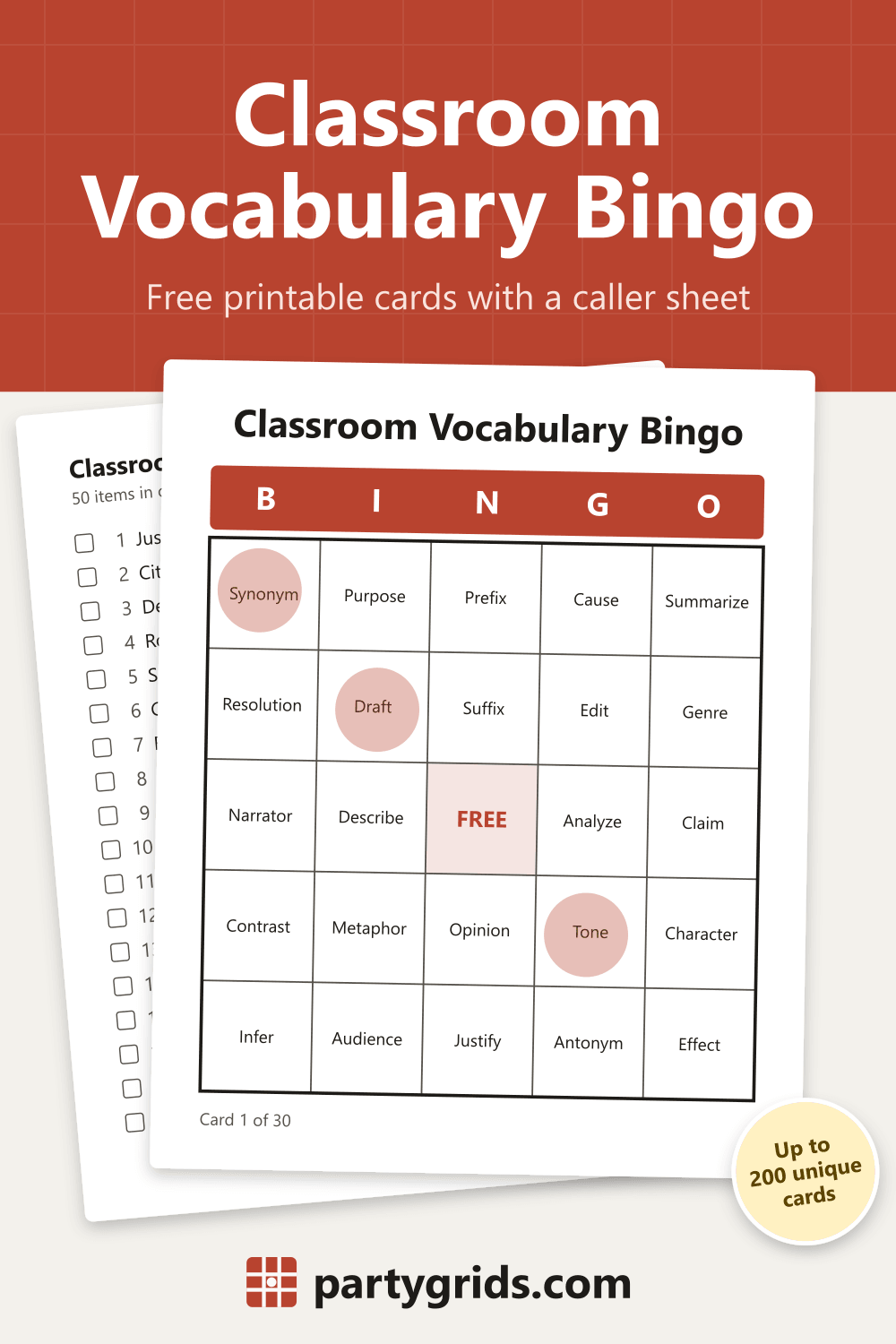
Classroom Vocabulary Bingo
| B | I | N | G | O |
|---|---|---|---|---|
Synonym | Purpose | Prefix | Cause | Summarize |
Resolution | Draft | Suffix | Edit | Genre |
Narrator | Describe | FREE | Analyze | Claim |
Contrast | Metaphor | Opinion | Tone | Character |
Infer | Audience | Justify | Antonym | Effect |
Card 1 of 30
Fifty academic vocabulary words from reading and writing lessons in grades three to six. The teacher reads a definition or a sentence with a gap; students find the word on their card.
Classroom Vocabulary Bingo
| B | I | N | G | O |
|---|---|---|---|---|
Synonym | Purpose | Prefix | Cause | Summarize |
Resolution | Draft | Suffix | Edit | Genre |
Narrator | Describe | FREE | Analyze | Claim |
Contrast | Metaphor | Opinion | Tone | Character |
Infer | Audience | Justify | Antonym | Effect |
Card 1 of 30
Classroom Vocabulary Bingo
| B | I | N | G | O |
|---|---|---|---|---|
Evidence | Conclusion | Sequence | Cite | Context clue |
Define | Evaluate | Main idea | Explain | Persuade |
Paraphrase | Compare | FREE | Classify | Root word |
Argument | Conflict | Detail | Revise | Theme |
Predict | Point of view | Simile | Setting | Dialogue |
Card 2 of 30
Vocabulary bingo is one of the few classroom games that is also a decent review activity, provided the caller never says the word. Read the definition ("a word that means the opposite of another word"), give the class five seconds, and students who know the answer mark "antonym". Students who don't know it hear the definition, see classmates mark a square, and can look at their own card for a word that fits, which is a small act of reasoning rather than a guess.
The list is the academic vocabulary that appears across subjects in upper elementary: the comprehension terms (main idea, infer, evidence), the literary ones (theme, setting, narrator, conflict), the word-study set (prefix, suffix, root word, context clue) and the verbs that show up in test questions and assignment instructions (analyze, evaluate, justify, paraphrase). Students meet these words in every subject, so a game that cements them pays off beyond the English lesson.
Say the word after a few seconds so everyone marks the right square and nobody is left behind, then move on. Keep the pace brisk; a round should feel like a game, not a quiz.
The last fifteen minutes of a Friday, the lesson before a vocabulary assessment, or the first lesson back after a break when the words need dusting off. Hand out cards once the class is seated and settled, and collect them at the end if you want to reuse them; the card numbers make it easy to give the same card back next time, or to swap cards deliberately.
A line for round one. A plus sign (middle row and middle column) for round two, since it needs eight marks and passes through the free centre. A full card as a longer activity when you want to get through the whole list: with 50 words it takes most of the list and nearly every definition gets read, which is the point.
Class points, first in line, choosing the read-aloud, a homework pass if that is part of your system, or the winner reads the next definition. Avoid sweets if the game is weekly; it adds up.
Cards are 5 x 5 with a free centre square. Edit the list, add your own squares or change the card size above; the cards update as you type.
The caller reads the definition, not the word. Students must know that "to work out something the text doesn't say directly" means "infer" before they can mark it. That turns a marking game into a retrieval exercise, and it is the reason vocabulary bingo belongs in a review lesson rather than a party.
Yes; that is the intended use. Replace the list with this week's words, or this term's, and keep at least 30 (48 is better) so the cards differ. Science, social studies and math vocabulary all work the same way. Save the share link for each unit and you have a set of games to reuse every year.
A line takes about five minutes at a definition-reading pace, and later rounds on the same cards are quicker, so three rounds fit a fifteen-minute review slot. Mix the patterns so students can't predict which squares matter.
No, it lists the words in call order with a tick box. Write or print your definitions beside it, or keep the glossary open. The word order is random, which is what you want for review; press Shuffle for the next lesson and the order changes.