ESL Beginner Bingo
| B | I | N | G |
|---|---|---|---|
Pen | Green | Milk | Egg |
Shoe | Bag | Door | Bread |
House | Flower | Goodbye | Bird |
Teacher | Father | Rain | Bed |
Card 1 of 30
Fifty of the first words an English learner meets: food, classroom objects, family, animals, colours, weather and greetings, on 4 x 4 cards. A listening game for the first weeks of class.
ESL Beginner Bingo
| B | I | N | G |
|---|---|---|---|
Pen | Green | Milk | Egg |
Shoe | Bag | Door | Bread |
House | Flower | Goodbye | Bird |
Teacher | Father | Rain | Bed |
Card 1 of 30
ESL Beginner Bingo
| B | I | N | G |
|---|---|---|---|
Dress | Happy | Clock | Banana |
Sun | Mother | Red | Window |
Shirt | Blue | Hello | Small |
Bicycle | Apple | Book | Car |
Card 2 of 30
A beginner's first problem is not grammar, it is hearing. A word said at normal speed by a teacher has to be recognised, matched to a meaning, and then found as a written word, all in a second or two. Bingo practises exactly that chain, with the pressure removed: the learner hears "window", scans a card of sixteen words, and either finds it or hears it again next round. Nobody has to produce anything. Nobody is called on. And the whole class is listening hard because everyone wants the line.
The list is deliberately mixed. It has the nouns a learner meets first (apple, chair, book, dog, house, bus), a few family words, four colours, four adjectives and the five words everyone learns on day one: hello, goodbye, please, thank you and friend. In the first month that mix is what the class knows; later, swap in a topic list.
Hand each learner a card and a pen, and teach the game with gestures and one example: say "apple", point to it on your own card held up to the class, cross it out. Then start. Say each word clearly, twice, at normal speed the second time. For a class with little reading, show a picture with each call. Learners cross out the word; the first to four in a row says "bingo", which needs no translation.
Check the winner by reading their crossed-out words aloud and having the class confirm each one with a thumbs up: that is a free round of listening for everyone. Then play again on the same cards for the next pattern.
On a 4 x 4 card, a line is four squares and the natural first round. Four corners is the same length and a change of shape. The frame (twelve outer squares) makes a longer round in which most of the list gets called, which is useful at the end of a unit. There is no free square on a 4 x 4 card.
In an adult class, the winner's reward is being the next caller, or simply the class's applause. For children, a sticker or choosing the next game. Keep it light; the game is practice, and losing is also practice.
Cards are 4 x 4. Edit the list, add your own squares or change the card size above; the cards update as you type.
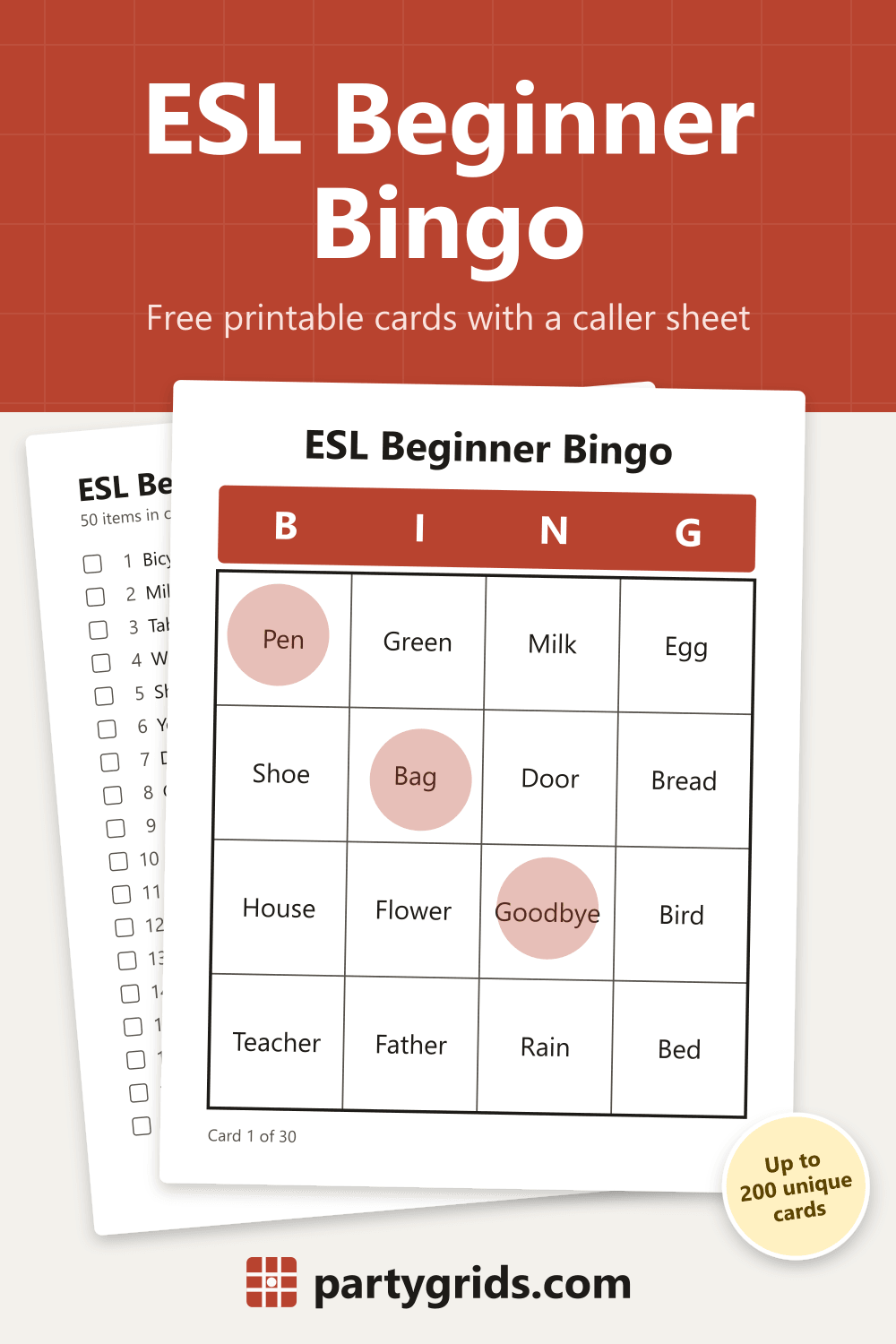
Yes, with pictures. Print the cards and have learners draw or stick a picture in each square before the game, or call each word while showing a picture card. Learners then match sound to picture to written word, which is exactly the connection a beginner needs to make.
Sixteen words is a manageable set for a beginner to hold in mind, the squares are large enough for a drawing, and a line needs only four marks, so rounds are short and nobody is lost for long. Move to 5 x 5 once the class is comfortable.
Yes. This list mixes several topics deliberately, so the game works in the first weeks. For a lesson on food, clothes or the classroom, replace it with 25 to 32 words from that topic (the generator notes when a short list makes the cards similar) and reuse the same cards for several lessons. Save the share link for each topic.
Very well. Adult beginners often dislike games that feel childish, and bingo doesn't: it is quiet, everyone plays at once, and nobody has to speak in front of the class. Use the words without pictures and let the winner call the next round for speaking practice.