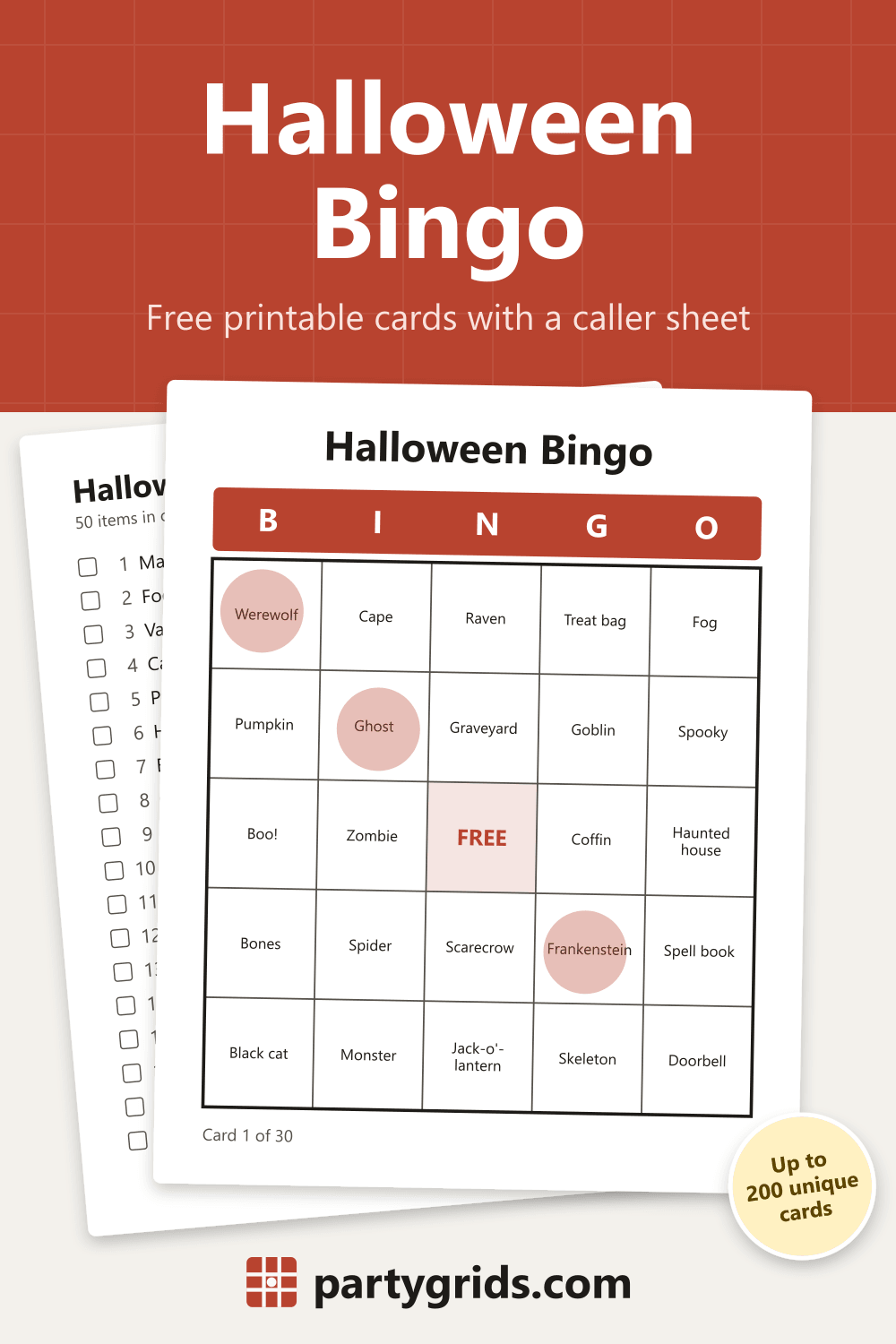
Halloween Bingo
| B | I | N | G | O |
|---|---|---|---|---|
Werewolf | Cape | Raven | Treat bag | Fog |
Pumpkin | Ghost | Graveyard | Goblin | Spooky |
Boo! | Zombie | FREE | Coffin | Haunted house |
Bones | Spider | Scarecrow | Frankenstein | Spell book |
Black cat | Monster | Jack-o'-lantern | Skeleton | Doorbell |
Card 1 of 30
Fifty Halloween words, from black cat to corn maze, on cards that are all different. Made for the classroom party on the thirty-first, and just as good for a family costume night.
Halloween Bingo
| B | I | N | G | O |
|---|---|---|---|---|
Werewolf | Cape | Raven | Treat bag | Fog |
Pumpkin | Ghost | Graveyard | Goblin | Spooky |
Boo! | Zombie | FREE | Coffin | Haunted house |
Bones | Spider | Scarecrow | Frankenstein | Spell book |
Black cat | Monster | Jack-o'-lantern | Skeleton | Doorbell |
Card 1 of 30
Halloween Bingo
| B | I | N | G | O |
|---|---|---|---|---|
Candy corn | Mummy | Candy apple | Eyeball | Mask |
Mad scientist | Vampire | Howl | Owl | Costume |
Potion | Pumpkin patch | FREE | Cobweb | Bat |
Cauldron | Fangs | Corn maze | Magic wand | Creaky door |
Skull | Witch | Ghost story | Broomstick | Full moon |
Card 2 of 30
Halloween parties at school have a particular problem: thirty children in costumes who have been thinking about sweets since breakfast. Bingo works because it is seated, it has a rhythm, and every call is a small event. It also fits the day: the words are the things they have been drawing and reading about all week, and a child in a vampire costume marking "fangs" is as happy as a child can be in October.
At home it is a good game for a mixed-age party, where a six-year-old and a twelve-year-old can play on equal terms. The older children help the younger ones find squares, which keeps everyone busy without a referee.
Call from the printed caller sheet, or put the caller on the projector so each word looms out of the dark in large letters. Say every word twice, with a bit of theatre: "Haunted... house." For early readers, hold up a picture or point to the word on the classroom word wall. Players mark their squares with a marker (candy corn works, and disappears at the end), and the first to a line shouts "Boo!"
Check the winner by reading their marked squares against your ticked sheet, hand over a prize, and start the next pattern on the same cards. Three rounds take about fifteen minutes.
A Halloween party has prizes built in: let the winner choose first from the treat bowl, pick the next song, wear the teacher's witch hat for the next round, or be the one who turns the lights down. Stickers, glow sticks and spider rings cost almost nothing and are prize enough. At a home party, the winner's costume is declared "scariest" for the night.
Cards are 5 x 5 with a free centre square. Edit the list, add your own squares or change the card size above; the cards update as you type.
It is written for a school party, so it is spooky rather than gory: witches, ghosts and skeletons, but no blood, knives or screaming. For kindergarten, cut it to the twenty simplest nouns (pumpkin, ghost, bat, cat, witch, spider, candy corn, moon, owl, mask and so on), switch to a 3 x 3 card and show a picture with each call.
Print the cards with words, then have students draw a small picture in each square before the game starts; it takes ten minutes and doubles as an art activity. Alternatively call with picture cards: hold up the picture, say the word, and let early readers match the word on their card.
Half-dark works well for atmosphere: project the on-screen caller so each word appears on the wall in large type, and give players glow sticks or small flashlights. Fully dark doesn't; nobody can find their squares.
"Boo!" is on the list for a reason. Tell players to shout it when they have a line. It is loud, quick to say, and younger children find it hilarious.
Far more than you need: with 50 words and 24 squares per card there are over a hundred trillion different sets. The generator makes up to 200 cards per game, which covers a whole grade.