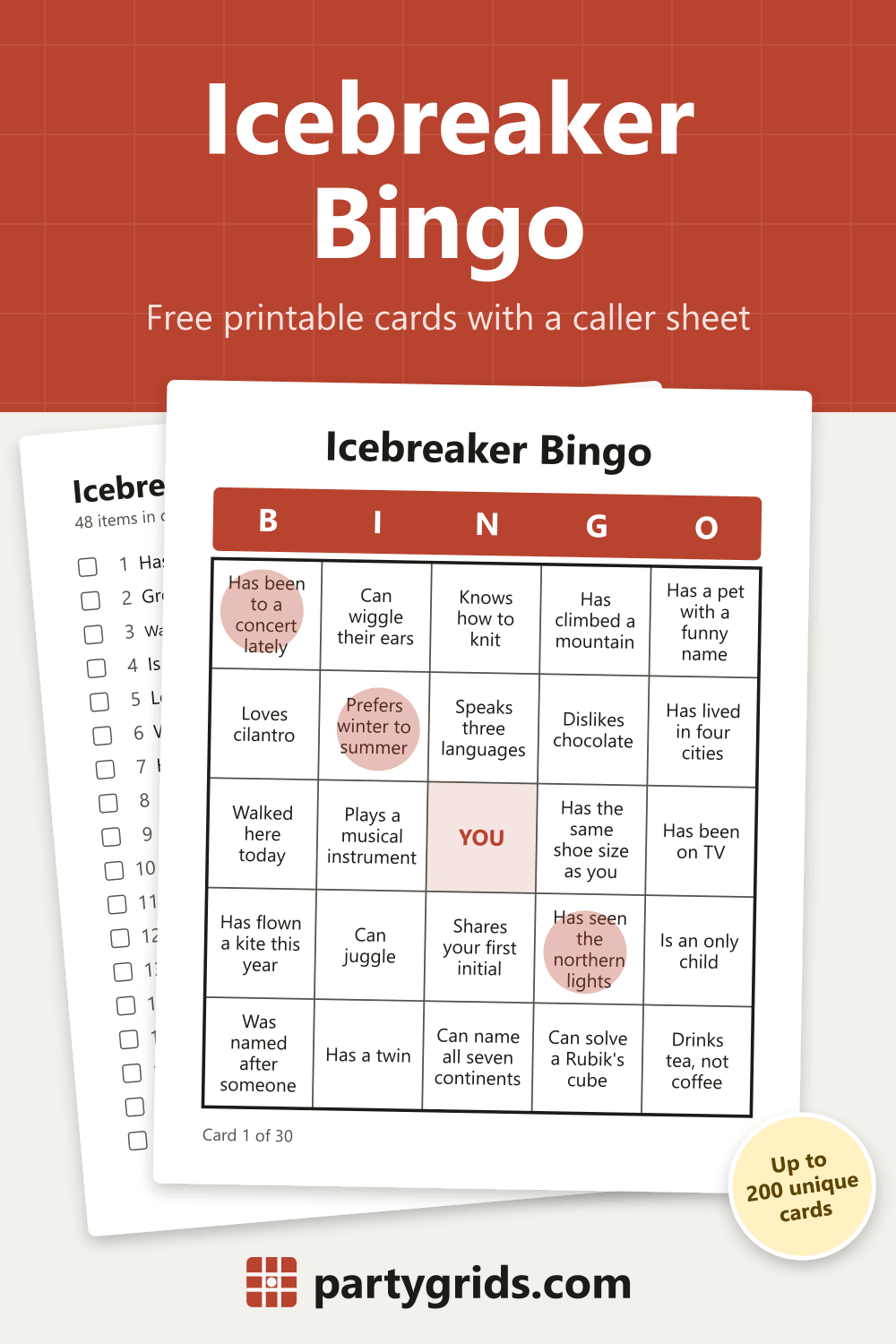
Human bingo for a room of strangers: forty-eight 'find someone who' squares, a card for each person, and twenty minutes of asking around. Written for orientations, first days of term and team offsites.
There is no caller and nothing is read out. Everyone gets a card and a pen, writes their own name in the centre square, and starts asking. "Do you have a twin? Have you ever been skydiving?" When someone says yes, they sign that square on your card. The first person to get a line, or a full card if you have time, calls out, and the host checks a couple of squares by asking the named people to confirm.
The bingo is a pretext. The game exists to make forty people talk to each other on a first day, and it works because a question on a card is easier to ask than "so, what do you do?" By the end of a round every player has had a dozen short conversations and knows at least one odd fact about each person they met.
When to use it
First day of term, from upper elementary to college orientation week.
New-starter orientation at work, especially a cohort that will train together.
Team offsites where two groups are merging and need an excuse to mix.
Conferences and meetups, as the first session after coffee.
Family reunions, with squares rewritten for the family.
Hand cards out at the door with a pen, not once people have sat down. Give a clear start and a clear stop: "You have fifteen minutes; when you hear the bell, sit down." Fifteen minutes is enough for a line in a room of thirty; twenty-five is enough for most people to fill a card.
Winning patterns for a mingling game
A line is the quick version and is what to use with a short time slot. A full card is better when the aim is to get everyone talking to everyone: it needs 24 different signatures, which in a room of 30 means meeting nearly everybody. For a very large room, play most squares in twenty minutes so the end is a count rather than a race. Whatever the pattern, finish by asking two or three winners to read out the most surprising square and who signed it. That minute of sharing is where the names stick.
Prizes
Small and immediate: a decent notebook, a coffee voucher for the café downstairs, first pick of seats, or simply the applause. At a conference, a book from the speaker's table. In a classroom, the winner chooses tomorrow's warm-up. The prize is not why anyone plays this one.
Printing
1 per page, so the squares are large enough to write a name in. This is the one bingo game where 4 per page doesn't work.
Plain paper and a clipboard or a hard-backed notebook per person if the room has no tables; people write while standing.
Leave the card numbers on so the host can check a winning card by asking "card 14, who signed 'can juggle'?"
Title the cards with the event name; no caller sheet is needed, so untick it before you download.
The 48 squares in this list
Cards are 5 x 5 with a free centre square. Edit the list, add your own squares or change the card size above; the cards update as you type.
Has a twin
Speaks three languages
Has run a marathon
Was born in another country
Plays a musical instrument
Has met a celebrity
Is left-handed
Has a pet reptile
Can juggle
Has never broken a bone
Has been skydiving
Loves cilantro
Shares your birthday month
Drinks tea, not coffee
Has climbed a mountain
Knows how to knit
Has lived in four cities
Can wiggle their ears
Can whistle with their fingers
Is the oldest sibling
Is an only child
Has been on TV
Can solve a Rubik's cube
Has ridden a horse
Keeps a houseplant alive
Finished a book this week
Walked here today
Has been to a concert lately
Can name all seven continents
Shares your first initial
Has won a trophy
Has seen the northern lights
Prefers winter to summer
Has flown a kite this year
Has worked in a restaurant
Can touch their toes
Owns a vinyl record
Went camping this year
Dislikes chocolate
Has a hidden talent
Has a pet with a funny name
Has been on a cruise
Grew up on a farm
Has the same shoe size as you
Collects something
Can do a cartwheel
Was named after someone
Bakes their own bread
Card 1 from this list, with a few squares marked. Every card in the set is different, and the caller sheet comes with them.
Frequently asked questions
What is human bingo?
A mingling game. Each square describes a person ("has a twin", "can juggle") and players walk round the
room asking questions until they find someone who matches, then write that person's name in the square.
First completed line, or first full card, wins. It is called icebreaker bingo, human bingo, people bingo or
"find someone who" bingo; they are all the same game.
Why does the centre square say "YOU"?
So that players write their own name in it. It is the free space, and it makes the point of the game
obvious in one glance: every square gets a name, including yours.
Can one person sign more than one square on a card?
Set the rule before you start. The standard rule is one signature per person per card, which forces
players to talk to at least 24 people. For a small group of ten, allow two or three per person. For a group
of 100, one per person and nobody will finish, which is fine.
How do I write squares for my own group?
Mix easy squares that half the room can sign (walked here today, drinks tea) with rare ones that one or
two people can (has seen the northern lights), and avoid anything that singles out appearance, religion,
health or family circumstances. Squares about skills, travel and taste are safe and lead to conversation.
Keep at least 30 so every card can have a different set of squares, and 48 or more so they feel different.
Do the cards need to be different?
Yes, more than in any other kind of bingo: players compare cards as they mingle, and different cards mean
different questions in every conversation. The generator makes every card's set of squares different
whenever the list is long enough, which 48 squares easily is.