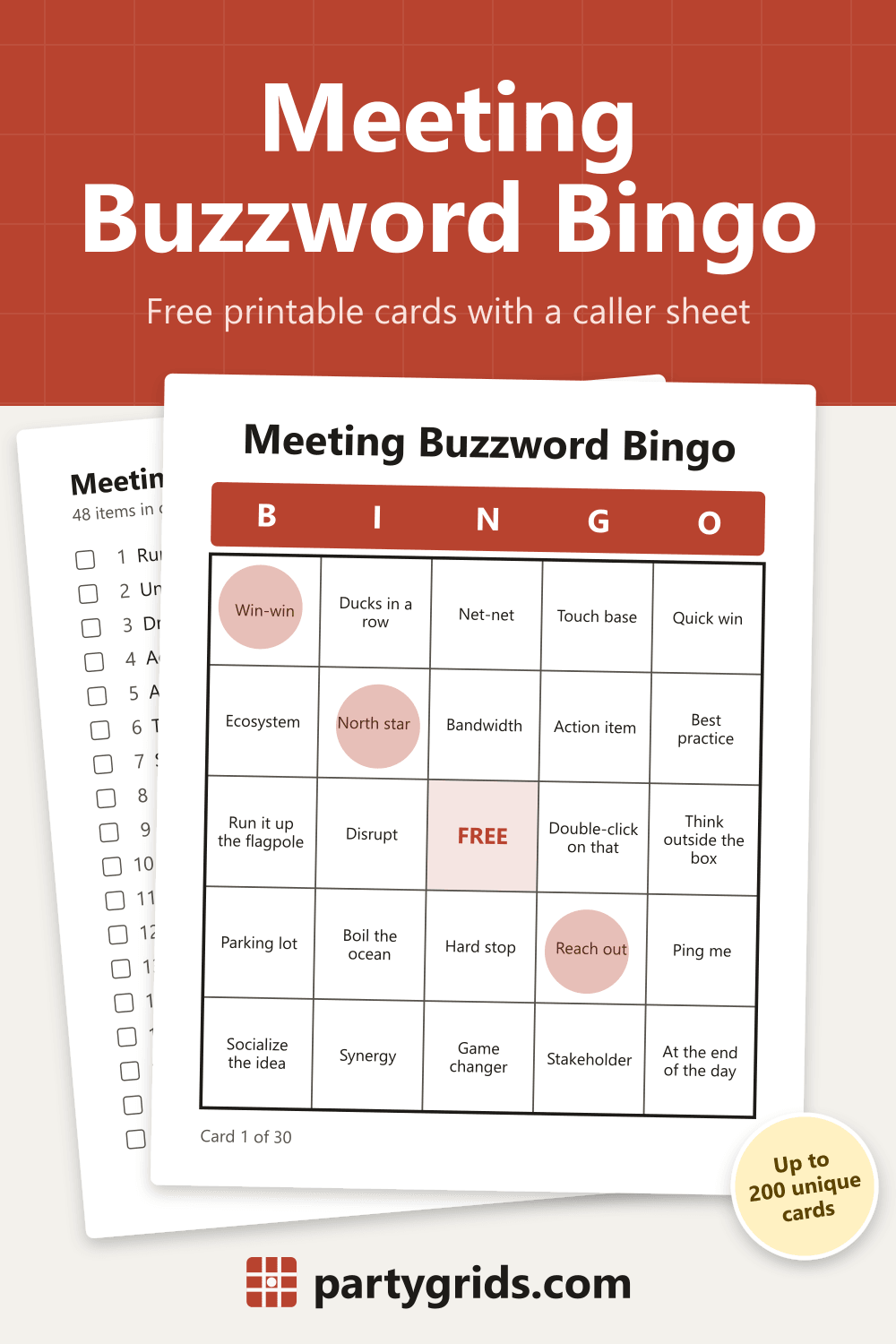
Forty-eight phrases that turn up in every all-hands, quarterly review and status call. Make a card for each colleague, mark the jargon as it is said, and see who gets a line before the Q&A.
Buzzword bingo has no caller: the meeting is the caller. Each player has a card of phrases, and every time a speaker says one, players with that square mark it. The first to complete a line wins, quietly or not, depending on the culture of the room. It has been played in offices since the early 1990s, and much of the vocabulary has barely changed since.
The list leans toward phrases that get said out loud in meetings rather than written in slide decks, and it includes the video-call era's contributions: "can everyone see my screen?", "you're on mute" and "let's take this offline". It is affectionate rather than cruel; most of us say half of these every week.
Two ways to play
Under the table. Make cards, share the link with the team, and everyone follows their own card on a phone or a printout. The first to a line sends "bingo" in the chat. The rule that keeps it harmless is that squares can only be marked when the phrase is said by someone else; nobody engineers a win by saying "paradigm shift" themselves.
On the table. For an offsite, a retro or a company anniversary, announce the game at the start. Hand out printed cards, name the winning pattern, and have the winner read out their line at the end. Presenters start avoiding the words, which makes the talk better and the squares harder, and the game becomes a running joke rather than a private one.
Timing and patterns
An hour-long all-hands produces plenty of calls: a line typically falls in the first twenty minutes. For a longer session use four corners or an X; for a two-day offsite, play for a full card and let it run as a background game across every session. For a fifteen-minute stand-up, drop to a 3 x 3 card with the nine most likely phrases.
Prizes that fit an office
The winner picks the next team lunch venue, gets the good chair for a week, chooses the next retro's icebreaker, is excused from note-taking at the next meeting, or wins a company-branded mug they probably already have. In a hybrid team, the remote winner gets a coffee delivered. Keep it small; the point is the line, not the prize.
Printing and sharing
For a remote team, don't print: send the share link, and each person finds their card number and keeps their own tally as the phrases land.
For a room, print 4 per page on plain paper and hand cards out face down with the agenda. Leave the card numbers on so you can settle a dispute by checking who had what.
Set the header row to something other than BINGO, such as "ALIGN" or "SCALE", to match the theme.
Change the title on the cards to the meeting's own name and date ("Q4 Business Review Bingo, Oct 14").
The 48 squares in this list
Cards are 5 x 5 with a free centre square. Edit the list, add your own squares or change the card size above; the cards update as you type.
Synergy
Circle back
Low-hanging fruit
Move the needle
Deep dive
Bandwidth
Touch base
Take this offline
Align
Leverage
Paradigm shift
Think outside the box
Best practice
Action item
Going forward
At the end of the day
Boil the ocean
Quick win
Stakeholder
Value add
Pivot
Scalable
Core competency
Game changer
Ping me
Hard stop
Parking lot
Double-click on that
Net-net
Run it up the flagpole
Drill down
On my radar
Can everyone see my screen?
You're on mute
Let's table that
Ducks in a row
Win-win
Reach out
Loop in
Unpack that
North star
Socialize the idea
Thought leader
Disrupt
Ecosystem
Holistic
Mission-critical
Bake it in
Card 1 from this list, with a few squares marked. Every card in the set is different, and the caller sheet comes with them.
Frequently asked questions
How do I play without the presenter noticing?
Open the share link on your phone to find your card and keep a quiet tally, or print one card per
player and keep it under a notebook. Nobody shouts bingo; the winner sends a single word in the group chat. The game is a
private way of staying awake, not a heckle, and it is kinder to the person presenting if it stays that
way.
Can I run it openly as a team-building game?
Yes, and that version is better. Announce it at the start of the all-hands, give everyone a card, and
have the first bingo winner read their line aloud. Presenters who know the game is on tend to play along
and avoid the squares, which is the whole point of the exercise.
Can I tailor the list to my company?
Please. Delete the phrases nobody at your company says and add the ones everyone does: the internal
project names, the acronyms, the CEO's favourite metaphor. Keep at least 30 squares, and 48 or more if you
want the cards properly varied. A card that is half
in-jokes is much funnier than a generic one.
Does each person need a different card?
It is better if they do, so that nobody wins at the same moment. With 48 phrases there are trillions of
possible 24-square sets, and the generator guarantees that no two cards in a game share one.