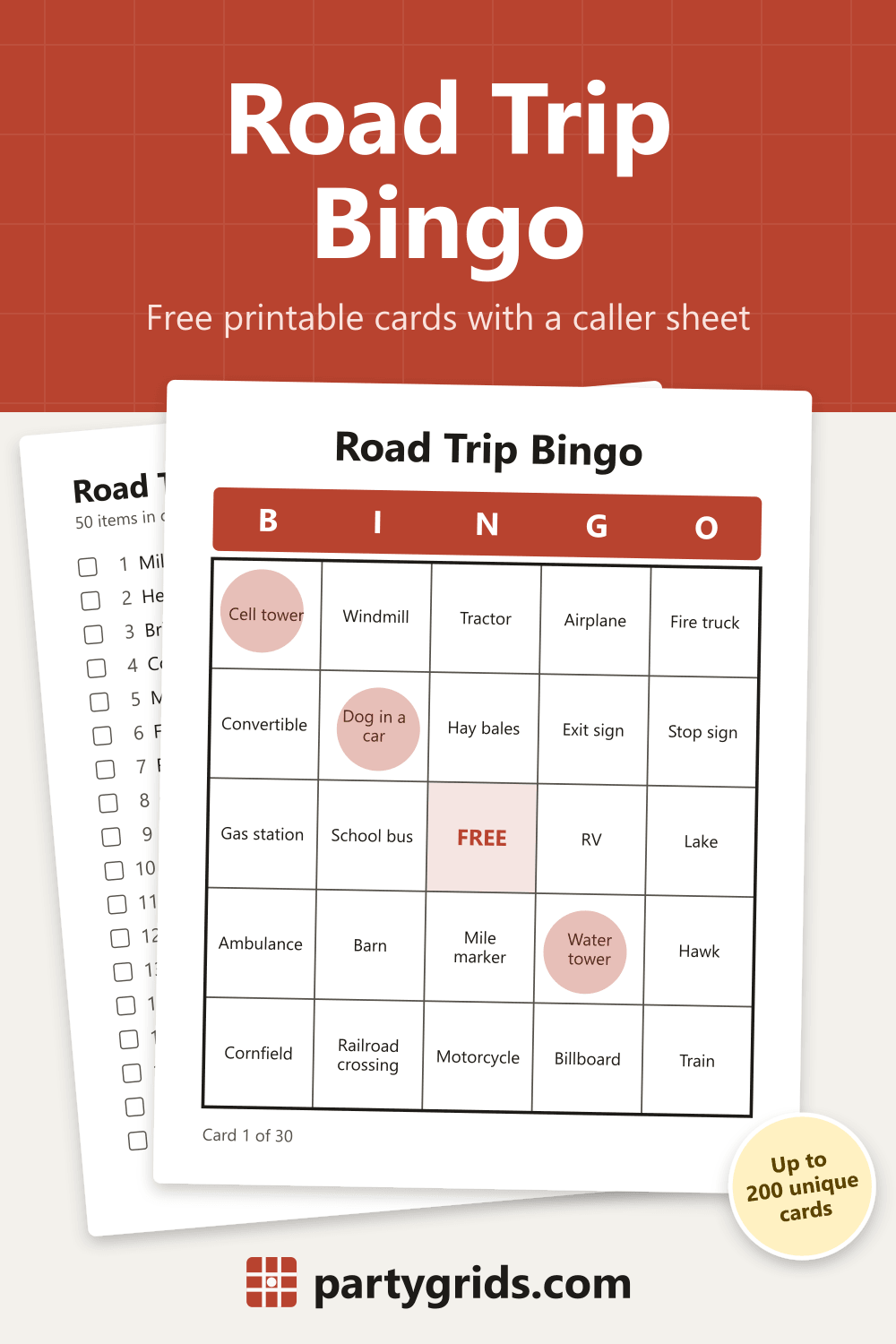
Fifty things to spot from a car window on a long drive: vehicles, animals, signs, bridges and barns. One different card per passenger, no caller, and a reason to look out of the window instead of at a screen.
Road trip bingo is spotting bingo. Everyone in the back has a card, and the road provides the calls: a motorcycle, a railroad crossing, a boat on a trailer, a dog with its head out of a car window. When you see the thing, you say it and mark it. A line wins the leg; a full card wins the trip. The game needs no adult attention beyond settling the occasional argument about whether that was a hawk or a crow, and it quietly teaches children to look at the country going past.
The list is built from a real long drive: things that turn up on most highways within an hour (red cars, semi trucks, billboards, exit signs), things that turn up a few times a day (water towers, tunnels, a church steeple, hay bales) and a handful of genuine finds (a rainbow, a helicopter, a roadside fruit stand) to keep the full card out of reach until the last hour.
Setting up before you leave
Print one card per passenger, including the front-seat passenger, who will otherwise be appointed referee full-time. Give each child a different card so they aren't racing for the same square, and a crayon or pencil rather than a marker that can migrate to the upholstery. Fold the cards in half and they fit in a seat-back pocket. Print a spare set for the way home; cards get lost under seats and rained on at rest stops.
Edit the list for the route first. The prefilled version is a general one for a rural highway. If the drive is through cities, swap the farm squares for urban ones; if it is a night drive, swap in lit things (neon signs, headlights, a lit water tower, a lighthouse).
Patterns for a long drive
Line for each leg between stops. Everyone starts a fresh card after a rest stop, or keeps marking the same one and goes for a second line.
Four corners as a short game for the last half hour before a stop.
Full card for the whole trip, with the first to fill their card at the destination the overall winner. With 50 squares on the list and a few rare items, this one usually isn't settled until the last hour.
Prizes on the road
Choosing the next playlist, the next snack, the window seat after the next stop, or who gets to pick the restaurant. For the overall winner, first pick of beds at the destination. The prize should be something that happens in the car, so the next leg starts with a reason to play again.
Printing
2 per page on card stock: big enough to mark on a lap, stiff enough to survive a week in a door pocket.
Put the destination and the date in the title ("Denver or Bust Bingo, July 2026"). These are the cards that end up in the scrapbook.
Untick the caller sheet; there is no caller. Leave the card numbers on so everyone knows whose card is whose after it has been dropped under the seat.
Laminate and use dry-erase markers if you take long drives regularly; the same cards work on every trip.
The 50 squares in this list
Cards are 5 x 5 with a free centre square. Edit the list, add your own squares or change the card size above; the cards update as you type.
Red car
Yellow car
Motorcycle
School bus
Police car
Fire truck
Ambulance
Tractor
Cow
Horse
Sheep
Deer
Hawk
Water tower
Windmill
Cell tower
Bridge
Tunnel
Train
Railroad crossing
Gas station
Rest area
Billboard
Speed limit sign
Stop sign
Exit sign
Mile marker
Out-of-state plate
Convertible
RV
Boat on a trailer
Semi truck
Traffic cone
Detour sign
Barn
Silo
Church steeple
Lake
River
Mountain
Cornfield
Hay bales
Airplane
Helicopter
Flag
Rainbow
Dog in a car
Bike rack
Toll booth
Roadside fruit stand
Card 1 from this list, with a few squares marked. Every card in the set is different, and the caller sheet comes with them.
Frequently asked questions
How is road trip bingo different from normal bingo?
Nobody calls. Each passenger watches the road and marks a square when they see the thing on it: a red
car, a water tower, a tractor. The first to a line wins that leg of the trip. Because the calls are the
landscape, the game can run for hours with no adult involvement, which is the entire point.
What stops children marking squares they didn't see?
The rule that you must say it out loud when you see it ("Windmill!") so a second person can confirm.
It also means the whole car looks up, which is the nicest thing about the game. Disputes go to the
front-seat passenger, whose decision is final.
What if we're driving somewhere with no cows?
Edit the list for the route: a city drive wants taxis, cranes, buses and bridges; a desert drive wants
cactus, mesas and dust devils; a coastal drive wants lighthouses, boats and surfers. Keep at least 30
squares (48 or more keeps the cards varied) and keep them things that appear every hour or so, not once a
trip.
Can we play on a phone instead of paper?
Each passenger can open the share link and find their card on a phone or tablet, but the squares can't
be tapped to mark them, so paper is better: it survives low battery, it can be marked with a crayon, and a
card held up against the window is a reminder to look out of it.