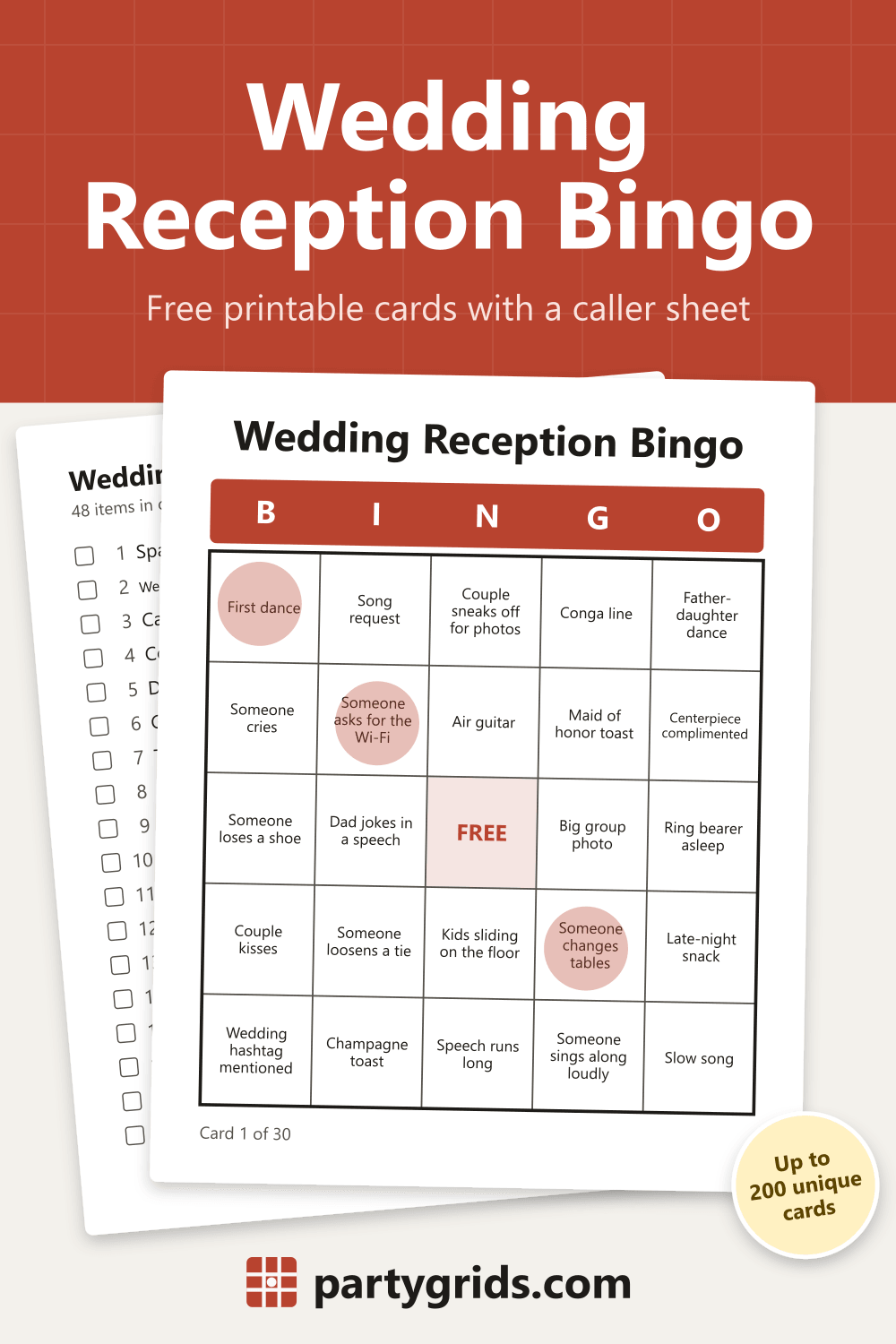
A table game for guests: each square is a moment that tends to happen at a reception, and guests mark them as they see them. Add a few squares about the couple and print one card per seat.
Reception bingo has no caller and no call sheet. The cards go out with the place cards, and over the course of the evening guests mark squares as the moments on them happen: the first dance, someone crying during the toasts, the DJ playing a group dance song, a shoe lost on the dance floor. The game runs itself for four hours and gives cousins who have never met a reason to lean over and say "did you get 'cake smash'?"
Because the calls are events rather than words from a list, every card is a slightly different prediction of the night. A table full of guests comparing cards after the speeches is the point; the bingo itself is almost secondary.
Setting it up
Edit the list first. Remove anything that won't happen at this wedding (no garter toss? delete it; dry reception? drop the champagne squares) and add three or four squares that only this couple's guests would get. Keep at least 30 squares, and ideally 48 or more so the cards stay properly varied (the generator says so below that). Then print one card per guest with a few spares, title them with the couple's names and the date, and put one at each place setting or inside the ceremony program.
Put the rules on a small sign at each table or a slip tucked behind each card: what the winning pattern is, when the game ends, and who to bring a winning card to. Guests should not have to find the host to ask.
Patterns that work over a long evening
A single line can be completed during the speeches alone, which is too early. Better options:
Most squares by the cake cutting. Everyone stays in all night, nobody needs a line, and a late table isn't out of it. Ties go to whoever hands their card in first.
Frame (the outer 16 squares): hard enough to last until the dancing.
Two lines as a race, with the winner announced by the DJ. Loud, quick, and good for a younger crowd.
Prizes guests will actually want
Skip the bottle; with children and non-drinkers in the room it is the wrong prize. Better: a framed print of the couple's engagement photo, the centrepiece from the head table, a box of the wedding favour in a bigger size, a dance with the bride or groom, or the right to request the next song. If the couple are up for it, the winner gets to make a thirty-second toast.
Printing and paper
1 per page on a thick card stock in the wedding colours looks like stationery and survives a wet table. 2 per page is a good compromise for a large guest list.
Leave the card numbers on. They make it easy to tell whose card is whose when they are collected at the end, and a tidy way to pick a runner-up at random by card number.
Put a pen at every seat. Golf pencils are cheap, don't leak and match nothing, which is fine.
Print ten percent extra. Cards get used as coasters, folded into programs and taken home by children.
The 48 squares in this list
Cards are 5 x 5 with a free centre square. Edit the list, add your own squares or change the card size above; the cards update as you type.
First dance
Cake cutting
Bouquet toss
Garter toss
Best man toast
Maid of honor toast
Someone cries
Father-daughter dance
Mother-son dance
Champagne toast
Glasses clinked for a kiss
Slow song
Conga line
Group dance song
Someone loses a shoe
Flower girl dancing
Ring bearer asleep
Someone loosens a tie
Someone changes into flats
Photo booth props
Big group photo
Sparkler send-off
Someone dances with grandma
Late-night snack
Uncle owns the dance floor
Couple kisses
Guest book signed
Dress gets bustled
Speech runs long
Grand entrance
Dance floor packed
Kids sliding on the floor
Song request
Cake smash
Couple sneaks off for photos
Last dance
Centerpiece complimented
Someone changes tables
Air guitar
Dad jokes in a speech
Photographer lies on the floor
Someone sings along loudly
Couple lifted on chairs
Wedding hashtag mentioned
Selfie with the couple
Toast gets a big laugh
Someone asks for the Wi-Fi
Bridesmaid fixes the dress
Card 1 from this list, with a few squares marked. Every card in the set is different, and the caller sheet comes with them.
Frequently asked questions
Who calls the squares at a reception?
Nobody. Reception bingo is self-marking: guests watch for the moments on their card and mark them as
they happen. The host's job is only to say how winners are confirmed, usually by showing the card to a
named person (the best man, the planner) who decides whether "uncle owns the dance floor" has really
occurred.
Will the couple mind?
Ask them. Most couples like it, because it gets the tables that don't know each other talking, but it is
their day. Keep the squares kind: this list has nothing about family arguments, drunk relatives or the dress,
and yours shouldn't either.
When does the game end?
Set a cut-off such as the cake cutting or the last dance, and name where the winning card should be
brought. Reception timelines slip, so a named event is better than a time. Many hosts run it as "most squares
by the cake" rather than a race for one line, so late arrivals can still win.
Can I add squares about the couple?
Please do; it is the best part. "Groom says 'literally'", "bride mentions the dog", "anyone references
how they met". Three or four personal squares among the general ones are plenty, and they are the squares
guests will talk about.
How many cards for a wedding of 120?
One per guest, up to 200 per game. With 48 squares on the list the generator can make 120 cards that are
all different and still keep every card's set of moments different. Print 4 per page: 30 sheets.