Thanksgiving Crossword
Sixteen answers, from the Mayflower and the Wampanoag to the drumstick, linked in one numbered grid with Across and Down clues and an answer key. Written for fourth to sixth grade, as a review after a lesson on Plymouth or a quiet task for the short week before the break.
Your crossword
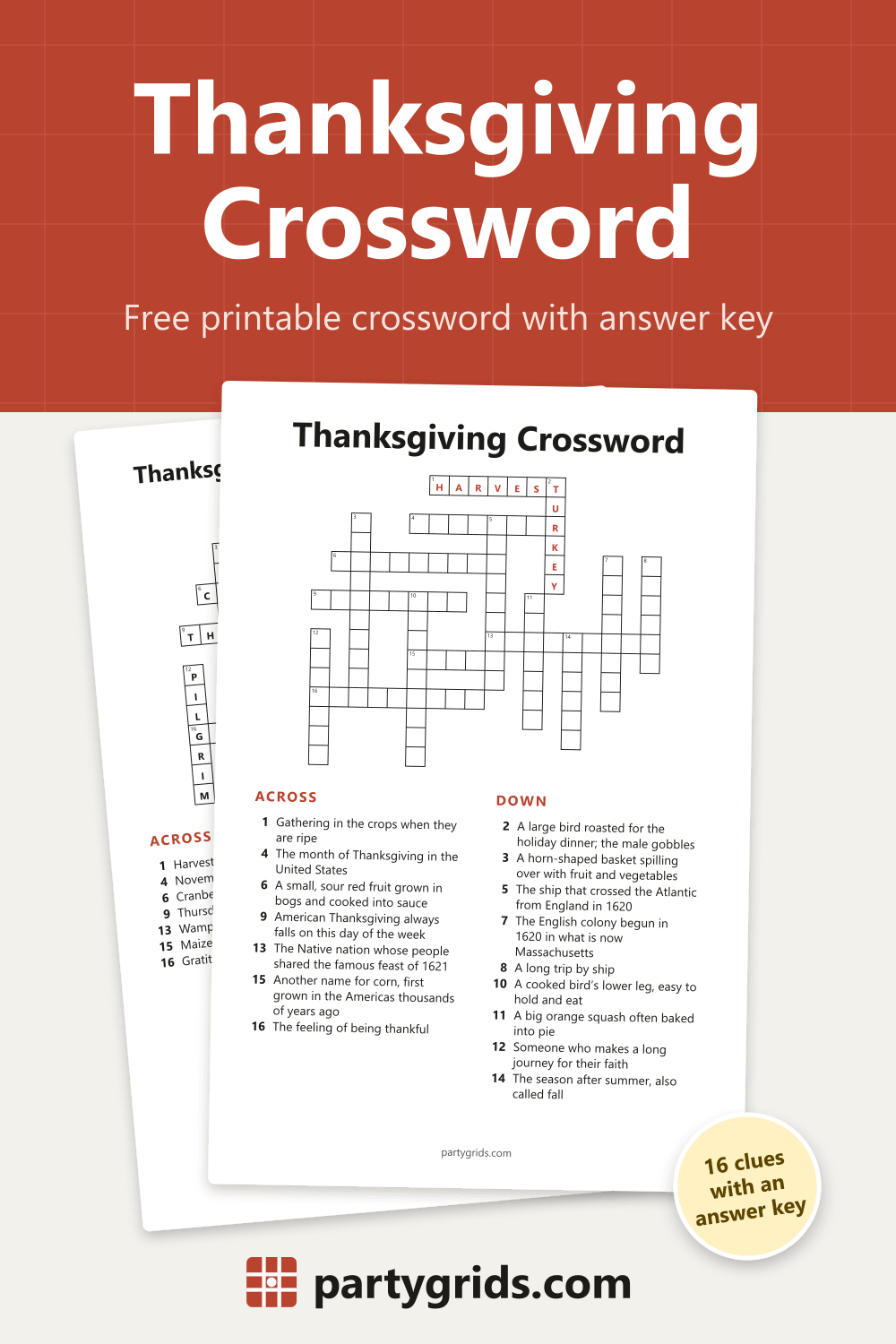
Preview · 15 x 18 · 16 answers placed
Thanksgiving Crossword
| 1 | 2 | ||||||||||||||||
| 3 | 4 | 5 | |||||||||||||||
| 6 | 7 | 8 | |||||||||||||||
| 9 | 10 | 11 | |||||||||||||||
| 12 | 13 | 14 | |||||||||||||||
| 15 | |||||||||||||||||
| 16 | |||||||||||||||||
Across
- 1Gathering in the crops when they are ripe
- 4The month of Thanksgiving in the United States
- 6A small, sour red fruit grown in bogs and cooked into sauce
- 9American Thanksgiving always falls on this day of the week
- 13The Native nation whose people shared the famous feast of 1621
- 15Another name for corn, first grown in the Americas thousands of years ago
- 16The feeling of being thankful
Down
- 2A large bird roasted for the holiday dinner; the male gobbles
- 3A horn-shaped basket spilling over with fruit and vegetables
- 5The ship that crossed the Atlantic from England in 1620
- 7The English colony begun in 1620 in what is now Massachusetts
- 8A long trip by ship
- 10A cooked bird’s lower leg, easy to hold and eat
- 11A big orange squash often baked into pie
- 12Someone who makes a long journey for their faith
- 14The season after summer, also called fall
Who it is for
Fourth to sixth grade. The clues are plain definitions, and the answers fall into three groups: the crossing and the colony (Mayflower, voyage, pilgrim, Plymouth), the people who were already there and the harvest (Wampanoag, maize, harvest, cornucopia), and the holiday as it is kept today (November, Thursday, turkey, cranberry, pumpkin, drumstick). Autumn and gratitude belong to all three.
Wampanoag and cornucopia are the hardest to spell, and the crossing letters help with both: a student who has the answers across them only has to fill the gaps. It suits a class that has already heard the story, because the clues test what was learned rather than teach it.
After a history lesson
Hand out the puzzle at the end of the lesson as a check on what stuck. When it is done, read the clue for Wampanoag aloud and ask what else the class knows about the feast. The fullest account comes from a colonist's letter of December 1621, one of only two written by people who were there: it says about ninety Wampanoag men came, stayed for three days and brought five deer. Then ask what the letter leaves out. It says nothing about pie or cranberry sauce, and a holiday on a set Thursday in November came more than two hundred years later.
In class and at home
- The short week. When the school week before the break is only a couple of days long, a crossword is a calm task that checks itself: a wrong answer puts a letter in the way of the answer crossing it.
- Early finishers. Keep a stack on the side table all week, with the answer key face down next to it so students can mark their own.
- Before dinner. At home, it suits the older children while the turkey rests. Print one per child, or one between two with a pencil each.
Easier or harder
For third grade, tick "Add a word bank" so the answers print under the clues, and say Wampanoag, cornucopia and gratitude aloud together before the puzzle starts. Solving in pairs helps too: one reads the clue, the other counts the squares.
For a stronger class, leave the word bank off (it is off when the page opens) and rewrite the history clues as questions only your lesson answers, such as "The ship whose passengers signed a compact before they went ashore" for Mayflower. Press Shuffle to make a second layout of the same clues for the other half of the room.
Printing
The puzzle prints on one page, grid above and clues below, and the answer key on the next, filled in and with every answer listed. Print a class set of page one and keep a single key. Cream or pale orange paper looks seasonal and keeps the numbers in the squares easy to read.
The 16 answers and their clues
The grid is 15 x 18, with 7 answers across and 9 down. Edit an answer or a clue above and the puzzle is rebuilt as you type; Shuffle gives another layout of the same answers.
Show the answers and clues
- Mayflower
- The ship that crossed the Atlantic from England in 1620
- Wampanoag
- The Native nation whose people shared the famous feast of 1621
- Plymouth
- The English colony begun in 1620 in what is now Massachusetts
- Pilgrim
- Someone who makes a long journey for their faith
- Voyage
- A long trip by ship
- Maize
- Another name for corn, first grown in the Americas thousands of years ago
- Harvest
- Gathering in the crops when they are ripe
- Cornucopia
- A horn-shaped basket spilling over with fruit and vegetables
- Gratitude
- The feeling of being thankful
- Autumn
- The season after summer, also called fall
- November
- The month of Thanksgiving in the United States
- Thursday
- American Thanksgiving always falls on this day of the week
- Turkey
- A large bird roasted for the holiday dinner; the male gobbles
- Cranberry
- A small, sour red fruit grown in bogs and cooked into sauce
- Pumpkin
- A big orange squash often baked into pie
- Drumstick
- A cooked bird’s lower leg, easy to hold and eat
Frequently asked questions
How accurate is the history in the clues?
The clues keep to what historians agree on: the Mayflower crossed from England in 1620, the colony at Plymouth was begun that year in what is now Massachusetts, and Wampanoag people were at the feast of 1621. Maize had been grown in the Americas for thousands of years before any of them arrived. Details that are still argued over, such as exactly what was eaten at the feast, are left out of the puzzle.
We are in Canada. Can I change it?
Yes, in two lines. Thanksgiving in Canada is on the second Monday of October, so replace the Thursday line with "Monday: Canadian Thanksgiving falls on this day of the week" and the November line with "October: The month of Thanksgiving in Canada". All sixteen answers still fit in one grid. The Plymouth answers are about the American story, so you may also want to swap a few of them for harvest words of your own.
Why is pilgrim clued as a word rather than as the Mayflower passengers?
Because the word has a meaning of its own, someone who makes a long journey for their faith, and that is why the name was later given to the Plymouth settlers. It also keeps the clue true: fewer than half of the people on the Mayflower belonged to the church group that made the voyage for its faith, and the rest came for work or a new start. Calling all of them Pilgrims is a habit that began long after 1620.
Is it too hard for the kids' table?
As printed, yes, for children under about nine. Tick "Add a word bank" and it becomes a matching puzzle that a seven-year-old can do with a little help, or give younger cousins the Thanksgiving word search instead. For a family puzzle, add a few answers of your own with clues about your Thanksgiving: the town where the grandparents grew up, the dish someone always brings, the street the family lived on. The grid is rebuilt around them.
Is there Thanksgiving bingo to go with it?
Yes. Thanksgiving bingo has fifty dinner-table words for everyone to play at once after the meal. The crossword and the word search are for one or two people at a time, which makes them better for the wait before it.
More games and guides
- All themesEvery prefilled bingo game, word search and crossword, from baby showers to buzzword bingo.
- Thanksgiving BingoEvery player gets a different card from 50 squares, with a caller sheet.
- Thanksgiving Word Search18 words hidden in a 15 x 15 grid, with an answer key.
- Crossword makerStart from a blank list: type your own answers and clues and print with an answer key.