Sight Words Word Search
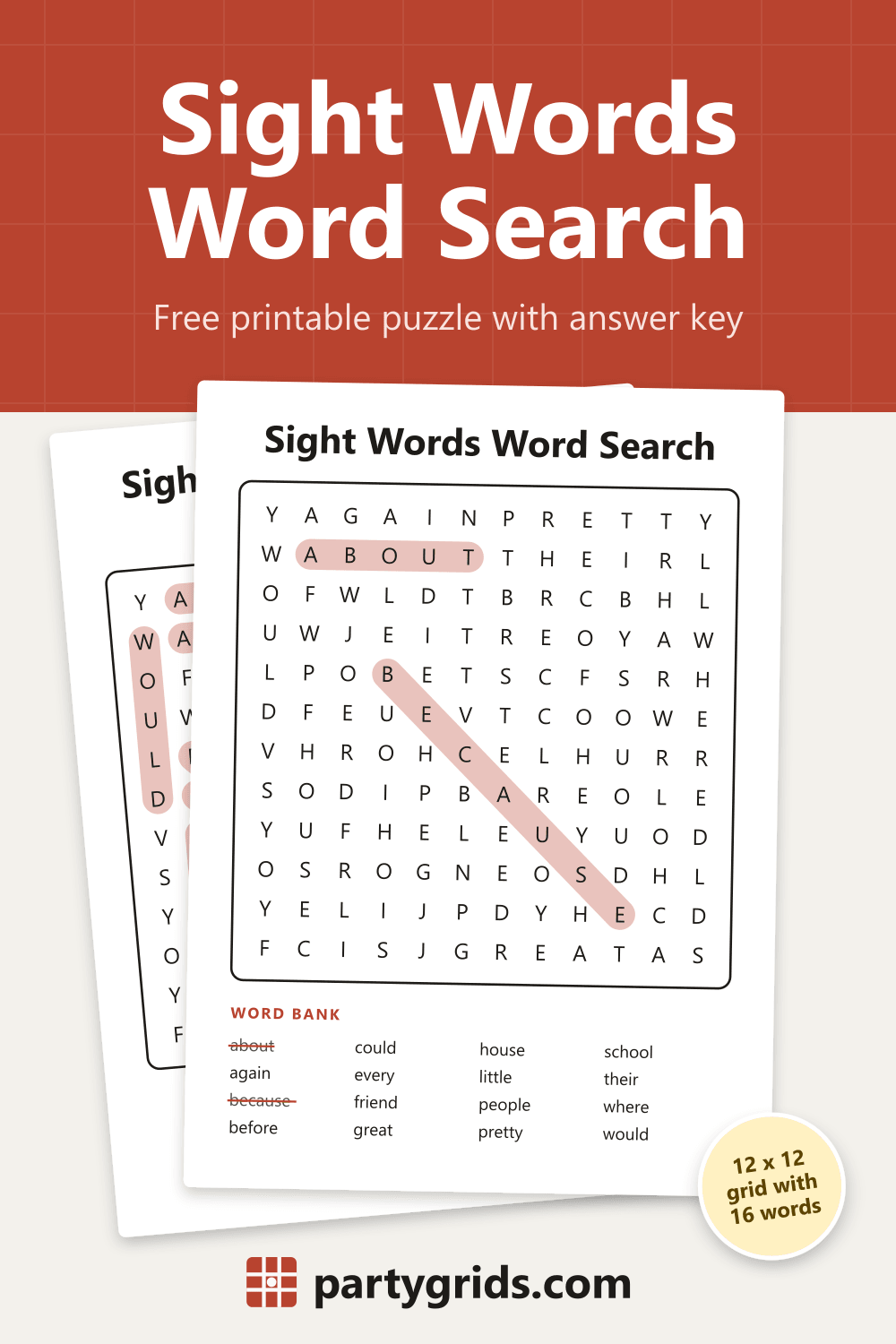
Sixteen first-grade sight words hidden forwards, down and on one diagonal, never backwards, on a small 12 x 12 grid with a word bank and a separate answer key. Swap in your own weekly list and print a class set.
Your puzzle
Preview · 12x12 · 16 words placed
Sight Words Word Search
| Y | A | G | A | I | N | P | R | E | T | T | Y |
| W | A | B | O | U | T | T | H | E | I | R | L |
| O | F | W | L | D | T | B | R | C | B | H | L |
| U | W | J | E | I | T | R | E | O | Y | A | W |
| L | P | O | B | E | T | S | C | F | S | R | H |
| D | F | E | U | E | V | T | C | O | O | W | E |
| V | H | R | O | H | C | E | L | H | U | R | R |
| S | O | D | I | P | B | A | R | E | O | L | E |
| Y | U | F | H | E | L | E | U | Y | U | O | D |
| O | S | R | O | G | N | E | O | S | D | H | L |
| Y | E | L | I | J | P | D | Y | H | E | C | D |
| F | C | I | S | J | G | R | E | A | T | A | S |
Words to find
- about
- again
- because
- before
- could
- every
- friend
- great
- house
- little
- people
- pretty
- school
- their
- where
- would
Why a word search for sight words
Sight words are the high-frequency words children are asked to recognise instantly rather than sound out: "could", "their", "because". The way to make a word automatic is to meet it many times, and a word search is a quiet way of adding a dozen careful meetings. To find "because" a child has to read it in the word bank, hold the letter string in mind, and compare it letter by letter against the grid, several times, until it matches. That is closer attention than most worksheets get.
This puzzle is set up for the age group. The grid is small (12 x 12, so a word is never far from where the eye starts) and the words run only left to right, top to bottom and down-right, never backwards, so every hidden word reads the way children read. Untick "Let words cross" if you want every found word to circle cleanly without sharing a letter with another. The word bank is printed under the grid in the same spelling children see on the word wall.
Using it in class
- Friday consolidation. The week's list goes in on Monday; the puzzle is the Friday activity. Ten minutes, then swap and check with the answer key.
- Early finishers. A laminated copy in the finished-work tray, with a dry-erase marker, is always welcome and never needs explaining.
- Partner reading. One child finds, the other reads the word aloud and ticks it in the bank. Swap halfway.
- Home practice. Send the puzzle home instead of a list to copy out. Parents find it easier to sit with, and the answer key means they can check it.
Making it easier or harder
For children who find the grid overwhelming, untick the diagonal, shrink the grid to 10 x 10 and use eight words; the puzzle becomes almost a matching exercise. For a confident group, add the second diagonal, go to 15 x 15, or fold the word bank under and give the words orally one at a time. For a child who needs the challenge of spelling, cover the word bank and read out each word's definition instead.
Printing
Letter or A4, one puzzle per page with the word bank underneath, and the answer key on a second page. Print the key once; print the puzzle for the class. The letters are large on a 12 x 12 grid, which suits children who are still forming letters themselves. If you laminate, a dry-erase marker in a light colour lets the letters show through the circle.
The 16 words in this puzzle
The grid is 12 x 12. Edit the words, the grid size or the allowed directions above and the puzzle is rebuilt as you type.
- about
- again
- because
- before
- could
- every
- friend
- great
- house
- little
- people
- pretty
- school
- their
- where
- would
Frequently asked questions
Which sight words are in the puzzle?
Sixteen words from the first-grade range of the common high-frequency lists: about, again, because, before, could, every, friend, great, house, little, people, pretty, school, their, where and would. They are the irregular ones children can't sound out, which is why extra exposure helps.
Why is nothing hidden backwards?
Six-year-olds are still learning to scan left to right, and a word printed backwards undoes that. Words here run forwards, down and along one downward diagonal, all in the direction children read, so the puzzle reinforces the habit instead of fighting it. For the youngest readers untick the diagonal and the puzzle is forwards and down only; add the second diagonal from second grade.
Can I use my class's own list?
Yes. Replace the words with this week's list, from any programme. Ten to sixteen words fit a 12 x 12 grid; if you want all of a longer list, go up to 15 x 15. Save the share link for each week and you have a puzzle ready every Friday.
How do I use it as a literacy centre?
Print the puzzle and the answer key, laminate both, and put them in the centre with dry-erase markers. Children find and circle the words, then check against the key themselves. Ask them to read each word aloud to a partner as they find it, so the puzzle practises reading as well as spotting.
More games and guides
- All themesEvery prefilled bingo game, word search and crossword, from baby showers to buzzword bingo.
- Word search makerStart from a blank list, choose the grid size and directions, and print with an answer key.
- Bingo card generatorMake matching bingo cards from the same word list for a second activity.