Science Word Search
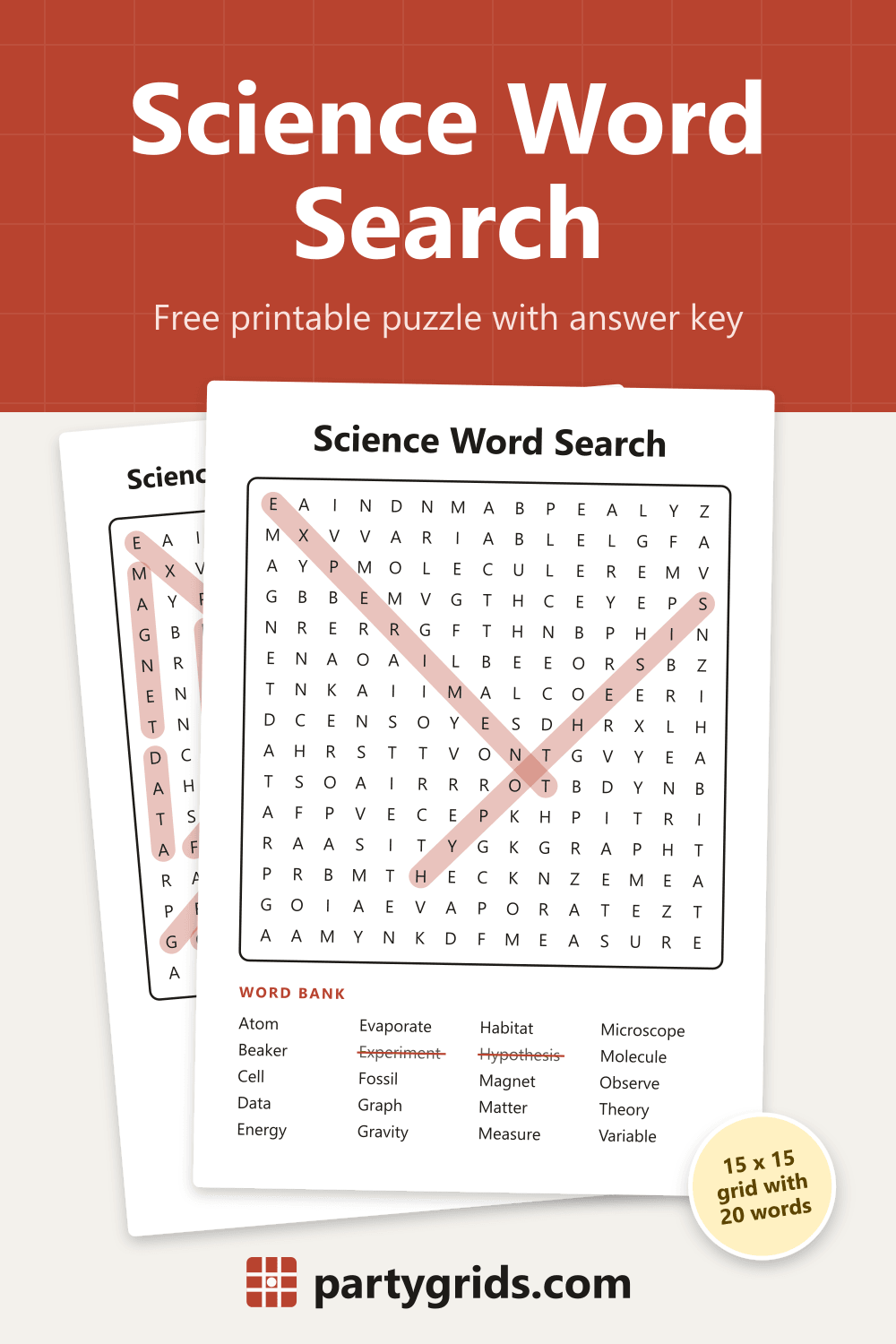
Twenty words from the first weeks of any science course, from hypothesis to microscope, on a 15 x 15 grid with an answer key. A starter, an exit task or a substitute's lesson for grades five to eight.
Your puzzle
Preview · 15x15 · 20 words placed
Science Word Search
| E | A | I | N | D | N | M | A | B | P | E | A | L | Y | Z |
| M | X | V | V | A | R | I | A | B | L | E | L | G | F | A |
| A | Y | P | M | O | L | E | C | U | L | E | R | E | M | V |
| G | B | B | E | M | V | G | T | H | C | E | Y | E | P | S |
| N | R | E | R | R | G | F | T | H | N | B | P | H | I | N |
| E | N | A | O | A | I | L | B | E | E | O | R | S | B | Z |
| T | N | K | A | I | I | M | A | L | C | O | E | E | R | I |
| D | C | E | N | S | O | Y | E | S | D | H | R | X | L | H |
| A | H | R | S | T | T | V | O | N | T | G | V | Y | E | A |
| T | S | O | A | I | R | R | R | O | T | B | D | Y | N | B |
| A | F | P | V | E | C | E | P | K | H | P | I | T | R | I |
| R | A | A | S | I | T | Y | G | K | G | R | A | P | H | T |
| P | R | B | M | T | H | E | C | K | N | Z | E | M | E | A |
| G | O | I | A | E | V | A | P | O | R | A | T | E | Z | T |
| A | A | M | Y | N | K | D | F | M | E | A | S | U | R | E |
Words to find
- Atom
- Beaker
- Cell
- Data
- Energy
- Evaporate
- Experiment
- Fossil
- Graph
- Gravity
- Habitat
- Hypothesis
- Magnet
- Matter
- Measure
- Microscope
- Molecule
- Observe
- Theory
- Variable
The vocabulary of the first unit
Every science course begins by teaching students how science is done, and that unit comes with a block of vocabulary that is used for the rest of the year: hypothesis, variable, experiment, observe, measure, data, theory. Students who are shaky on these words in September are still shaky in June. A word search is not how anyone learns what a variable is, but it is a painless way to make the spelling and the shape of the words familiar, so that when the definition is taught the word is already a known object.
The list adds a few concept words from physical and life science so the puzzle is not all abstract nouns, and so it can serve as a general review later in the year. Words run forwards, down and diagonally on a 15 x 15 grid, which is a moderate difficulty for the age group.
Three ways to use it
- Starter. On desks as students arrive; five minutes; then a quick round of "define a word you found". Settles the class and begins the lesson with the lesson's vocabulary.
- Definition match. Mask the word bank on the copier and give a numbered list of definitions. Students write the term beside each definition, then find it in the grid. Twenty minutes, and it is a real check of understanding.
- Substitute's lesson. A class set, the answer key and the instruction "find the words, then write each one in a sentence that shows what it means". Needs no subject knowledge from the substitute.
Difficulty and adaptations
As set, a sixth-grader finishes in about ten minutes. For a stronger class, allow all eight directions and enlarge the grid to 18 x 18; the long words (experiment, microscope, hypothesis) become genuinely hard to find backwards. For a class that needs support, drop to twelve words, keep forwards and down only, and let students work in pairs. The puzzle is rebuilt as you change settings, so you can print both versions from the same list.
Printing
One grid per page with the word bank under it; answer key on a second page. Print the key once for your desk. If you make a definitions version, cover the word bank when you copy the sheet and paste your definitions list in its place, or print the definitions on the back.
The 20 words in this puzzle
The grid is 15 x 15. Edit the words, the grid size or the allowed directions above and the puzzle is rebuilt as you type.
- Hypothesis
- Experiment
- Variable
- Observe
- Measure
- Data
- Graph
- Molecule
- Atom
- Energy
- Gravity
- Magnet
- Cell
- Fossil
- Habitat
- Evaporate
- Matter
- Microscope
- Beaker
- Theory
Frequently asked questions
What vocabulary does the puzzle cover?
The words every science course introduces in its first unit: the method (hypothesis, experiment, variable, observe, measure, data, graph, theory), the lab (microscope, beaker) and a sample of core concepts from physical and life science (atom, molecule, energy, gravity, magnet, matter, evaporate, cell, fossil, habitat).
Can I use it for a specific unit?
Yes, replace the list: states of matter, the water cycle, the parts of a cell, forces, the rock cycle. Fifteen to twenty terms fit the 15 x 15 grid. Keep the share link for each unit and reuse it every year.
Is a word search worth a science lesson?
Not a whole one. It is a five-minute starter or an exit task, and it earns its place when paired with something: define each found word, or match it to a diagram. On its own it practises spelling, which for words like hypothesis is not nothing.
Can I hide the word bank and give definitions instead?
The printed puzzle always carries the word bank under the grid, so fold it under or mask it on the copier, and hand out a numbered list of definitions instead. Students must work out the term first, then find it. The answer key still lists the words, so marking is simple.
More games and guides
- All themesEvery prefilled bingo game, word search and crossword, from baby showers to buzzword bingo.
- Word search makerStart from a blank list, choose the grid size and directions, and print with an answer key.
- Bingo card generatorMake matching bingo cards from the same word list for a second activity.